



The so-called 'Kaiserpfalz' (Emperor's Palatinate) is in fact a episcopal palace of the bishop of Bamberg. It was built between 1350 and 1400. Because of its fourteenth-century mural paintings, the oldest in Franconia, the Kaiserpfalz is widely known. Since 1911 the Museum of the Pfalz has been placed there. It is planned to extend the Kaiserpfalz to a "Pfalz of Culture" with new museums and a wide range of cultural institutions in the next few years.
In the early Middle Ages, when neither the king nor the emperor ('Kaiser') had fixed residences, the Pfalzes were built all over the country as 'temporary residences'. The king and his retinue travelled from Pfalz to Pfalz to do their business there. Such a Pfalz was in Forchheim, but neither the place nor the architecture are known today; the ancient Pfalz is not identical with the Kaiserpfalz. Historians of the eighteenth and nineteenth centuries considered the 'Kaiserpfalz' to be the ancient Pfalz, so the building is still erroneously called by that name.
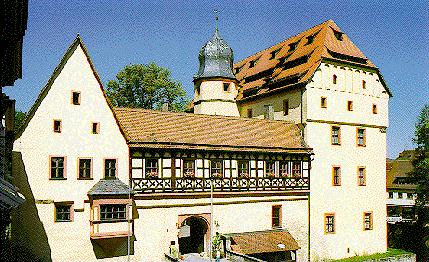
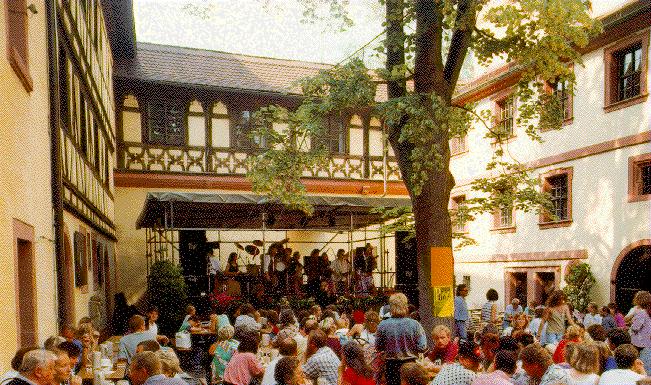
The castle was built by Lambert von Brunn, who was bishop of Bamberg at that time. The building originally consisted of the main wing (the east part of the building, where you now can visit the museum) and was surrounded by a ditch. In the middle of the sixteenth century parts of the ditch were filled up so that the western, north and south wings could be built on it. So the four wings surround a court.
The bishops of Bamberg used the castle as a second residence, to work there or just for prestigious purposes. In 'restless' times the castle was used as a refuge for the bishops because of the strong fortress of Forchheim.
In the beginning of the nineteenth century Forchheim was conquered by Bavaria. The castle was used for administrative purposes by the Bavarian kings since then. In the end it was used as police station. The city of Forchheim bought the building from Bavaria in 1988.
© 1995-2000 The WebFO-Team - All rights reserved